Last winter, I spent some time at the Detroit Historical Society helping to catalog photographs taken by former students at the College for Creative Studies. One day, I was going through some miscellaneous photographs of residential neighborhoods, and I began looking up the addresses of some of the homes. One photographer had taken a series of shots of some small single family homes on St. Aubin, and I didn't recognize the cross streets he listed under the photographs, so I was doing some Google Maps investigation. I couldn't seem to locate the intersections where these photos were supposedly taken. Google Maps told me they didn't exist, and I searched up and down St. Aubin a few times. I was starting to wonder if the photographer had made a mistake and completely mislabeled the photos. After searching the map several times, I realized that the huge space directly adjacent to the area in which I thought these homes would be located was the General Motors Hamtramck Cadillac Assembly Plant.
I didn't know too much about the Assembly Plant, besides that it was constructed on the site of a large immigrant community called Poletown. Poletown was one of the few communities still thriving in Detroit by the 1980s, but the city of Detroit seized it through eminent domain, claiming that the potential for job creation brought in by a new GM plant would outweigh the benefits of keeping the community intact.
The pictures I was looking at were taken in 1981, and they showed rows of homes which were in various states of disrepair but still appeared to be in decent shape. Many of them were located on a stretch of St. Aubin which was right on the edge of the Assembly Plant and, as far as I can tell, no longer exists. I had heard some vague rendition of the story of Poletown, but seeing pictures of entire city blocks which stood in 1981 but have completely disappeared made the whole thing seem more like reality and not just a piece of Detroit political history.
Of course, it's tough to know what conditions were like in Poletown in the 1980s without actually having lived there. Even by interviewing former residents of the neighborhood, I'm sure we would get conflicting opinions about the neighborhood's reaction to the deal. For example, David Schultz writes in Property, Power, and American Democracy that the Poletown Neighborhood Council (the organization created to oppose the demolition) was actually fairly unpopular among Detroit's Polish community, which saw the potential economic benefits of the plant's construction for nearby Hamtramck and was offered significant payments for relocating (pg. 101). On the other hand, it's important to remember that this was a community, and there was at least some segment of it that vigorously opposed the deal. Jeanie Wylie's book, Poletown: Community Betrayed, represents the viewpoint that it is an injustice any time a community is sacrificed for the benefit of some external power, and it is widely acknowledged that this expansion of eminent domain gave governments and corporations an unprecedented amount of control over private property. These complicated issues are always important to remember, especially as the city attempts to deal with its current land use issues by attempting to incentivize residents to move out of what it considers to be unsustainable neighborhoods through the Detroit Works project.
***
One of these photographs had a caption which read, "On St. Aubin between Henrie and Palmer," and it showed a row of six or seven houses. I located this block on Google Street View, and found that only one of the houses in this row remains, surrounded by trees but still appearing to be in good condition. The house is only a few blocks from the GM Plant and from I-94, which had done its own damage by splitting the community in half like so many Detroit freeways had done in other neighborhoods. Even though this block sits just outside the area demolished for the plant's construction, surely most of its inhabitants simply gave up and moved on to other places. I wonder if this house is occupied by some Polish family that was too stubborn to leave the neighborhood, like the few residents of Centralia, PA who refused to leave after a mine fire made the town uninhabitable. Maybe they choose to continue living in the house, painting the walls, and trimming the bushes as a symbol of this former immigrant community.

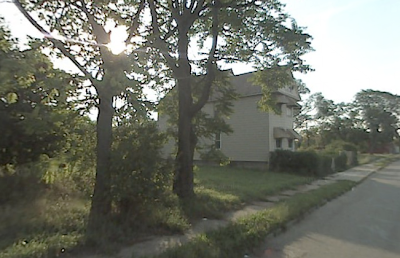
(photos from Google Maps)
***
Still, Poletown refuses to die. A few months ago, an article on detroitblog drew attention to St. Albertus Catholic Church, which is no longer an officially recognized church but is hanging on by a thread as a small group of people work to preserve it. A priest from Hamtramck occasionally bikes into the neighborhood to give masses to a handful of people. And the Ivanhoe Cafe, or "Polish Yacht Club" (not an actual yacht club, for the record), still serves fish and Polish food on a desolate section of Joseph Campau Street which was cut off from Hamtramck by the construction of the Assembly Plant. These people and others like them are evidence of the community's symbolic connection to this one random piece of land, and stories like this are repeated throughout Detroit's many forgotten neighborhoods.


